

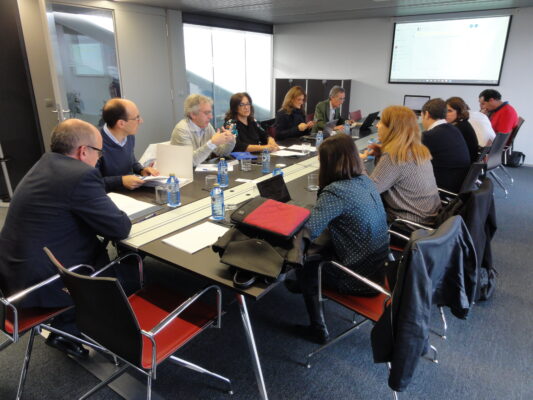
Novadays has provided technical, financial and legal support to three supra-autonomic operational groups under the European Association for Innovation in Agricultural Productivity and Sustainability (AEI-AGRI), being its innovation broker. The three Operational Groups have been created under the Ministry of Agriculture and Fisheries, Food and Environment (MAPAMA) and funded by the European Agricultural Fund for Rural Development (EAFRD).

The Operational Group "Identification and quantification of dairy components used in the manufacture of blended cheeses" is led by EURECAT, the Technological Center of Catalonia, and INLAC, the interprofessional dairy organization."is led by EURECAT, the Technological Center of Catalonia, and INLAC, the interprofessional dairy organization. It has been created in order to identify and quantify in an accurate and efficient way, through precision techniques, the different milks used in the production of blended cheeses.
During the past year, the Interprofessional Dairy Organization (Inlac) carried out an extensive survey on the current possibilities of identifying and quantifying the different milks used in the production of blended cheeses on the market. As a result of this study, it was determined that there is no methodology that guarantees such quantification due to the multiple factors that influence the reliability of the results.
In this sense, correct identification is a guarantee of transparency, fair competition and consumer confidence, since, in accordance with the provisions of RD 1113/2006 and European regulations on food labeling, cheeses made with milk from two or more species must indicate on their label the quantities of each type of milk used at the time of production, or in the case of using the name "mixed" cheese, the minimum percentages of each of them.
The main objective of the Task Force is to establish the theoretical basis for drafting the R&D project(s) to design appropriate methodologies and analytical techniques to identify and quantify the different types of milk (cow, sheep and goat), through the analysis of regulatory and administrative conditions, available techniques and the mapping of problems and solutions that improve existing ones and represent a competitive advantage for producers.
The Task Force is composed of a team of companies, associations, organizations and multidisciplinary research centers.
It is planned to extend the consortium to both cooperatives and industries to transfer the knowledge developed during the project.
More information on the web: http://quesos-mezcla.chil.org/
The Operational Group "Toolbox for the reduction of energy consumption in pressurized irrigation networks for vineyards" is an efficient irrigation project conceived within the framework of the National Rural Development Program, financed by the Ministry of Agriculture and Fisheries, Food and Environment (MAPAMA) and the European Agricultural Fund for Rural Development (EAFRD).
The EnerTool Project aims to integrate and transfer to the market the IT tools developed by R&D centers for the reduction of energy-related costs in the production of wine grapes and to carry out crop irrigation in a more efficient way, from an energy, economic and environmental point of view.
Several irrigation communities are already integrated in the Integral Management of Irrigation Communities program developed by SERINA. There are also several tools proposed by research centers, including, among others, Optired, developed by the IIAMA of the Polytechnic University of Valencia, Maeeb, from the Regional Center for Water Studies (CREA) of the University of Castilla-La Mancha, or the tool for the management of critical points in networks developed by the University of Cordoba.
The final objective is to determine the tools that should eventually constitute the Toolbox to cover all the needs of pressurized irrigation networks and how to approach the market so that the use of the Toolbox tools is economically viable and accepted by the users.
The Task Force is composed of a team of companies, associations, organizations and multidisciplinary research centers.
In a next phase, the next step will be the drafting of the Innovation Project in which the structure and development of the development of the Toolbox will be proposed, taking into account the different needs of the Irrigation Communities interested in the implementation of these tools.
More information on the website: http://www.geoscopio.net/empresas/enertool/
The Operational Group "Operational, legal, economic and financial models for the implementation of sustainable and competitive photovoltaic energy in agri-food facilities". conceived within the framework of the National Rural Development Program, financed by the Ministry of Agriculture and Fisheries, Food and Environment (MAPAMA) and by the European Agricultural Fund for Rural Development (EAFRD) within its plan to promote technological innovation in the primary sector in Spain.
The Alimenta Solar project aims to develop a framework for the efficient and profitable implementation of photovoltaic energy in the agri-food sector. This initiative will be oriented towards solving the main difficulties encountered by the agri-food sector in dealing with energy costs, which already account for 30% of production costs. The aim of this project is to achieve continuous improvement in energy efficiency and savings. The Task Force will focus on identifying the operational scenarios and the legal and economic-financial barriers to be resolved by the project.
The objective is to promote, through an operational model, a 20-30% reduction in the energy costs of companies and to reduce the exposure of the agri-food sector to the fluctuations of fossil fuel costs. This project aims to achieve a continuous improvement in energy efficiency, with the possibility of reinvesting energy cost savings in business strategies that result in greater environmental, economic and/or social sustainability of the companies. The Task Force will focus on identifying operational scenarios and legal and economic-financial barriers to be resolved by the project.
The Task Force is composed of:
More information on the website: https://autoconsumo.unef.es/