

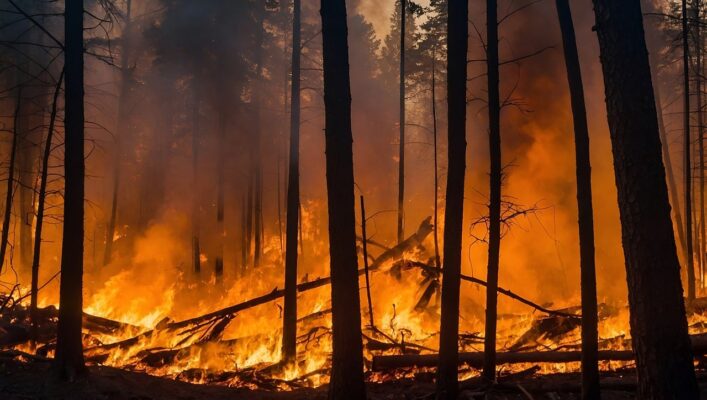
The challenge facing governments and institutions around the world is enormous. The devastation of thousands of hectares by the fires that occur year after year not only has consequences due to the uselessness of the land, but also has a strong impact on many other aspects:
Moreover, fires not only emit greenhouse gases, but also destroy ecosystems that serve as carbon sinks. These sinks contribute to the absorption of up to 50% of the CO2 emitted into the atmosphere.
On the other hand, the generalization of large fires and their spread to all areas of the planet have turned fires into a global public problem, which transcends the local, regional or national level and affects a large number of countries in general, often with effects far beyond the borders where the fire originates.
There are structural reasons for the occurrence of forest fires: climate change, poor management of the rural environment, human negligence and intentionality, poor urban planning or lack of respect for the natural regime of forest fires themselves are just some of them.
Minimizing or eliminating fire risks is not only a scientific problem, or a technical problem, but has become a public problem that demands global public action.
In this sense, all governments are now called upon to propose, design and implement public policies to mitigate or prevent forest fires. These policies must be able to act in all phases of fire management, in a comprehensive manner: from prevention, budgeting - aimed at improving interventions and safety - to repair.
New technologies are being put at the service of public administrations to enable them to manage fires more efficiently. Technologies such as artificial intelligence (AI), internet of things (IoT), Big Data and information and communications technologies are key to meet the challenge.
There are many scientific and technical advances in fire surveillance, detection and extinguishing, which can be used by public authorities: smoke sensors, remote monitoring systems, thermal surveillance cameras, gas detection systems, fire extinguishing robots, laser fire extinguishing systems, etc.
Among others, the use of unmanned aerial and terrestrial vehicles to monitor the state of forest lands in the tasks of care and prevention, as well as in the tasks of extinction, is one of the solutions that governments must increasingly implement. Solutions that offer multiple advantages, especially in areas that are difficult for humans to access.